Body: Patterns of Body Conectivity /Duncan Moves
Review
Choreutics
The Cube
Trace Forms
Diagonal Movement Scales
Kinesphere
Art Nouveau
Elements of Dance: Space (levels, directions, focus, pathways, size)
Breath patterning assists the coordination of the internal body that is vital in human movement. Functionally, every inhalation and exhalation is a complex event
I
Unit: Body
Theme: Patterns of Body Connectivity
II
Introduction
Today we will review Laban's concept of body connectivity. | Fundamental patterns of total body connectivity was articulated by Bartenieff. It is also useful to acknowledge Hackney's six Fundamental Patterns of Total Body Connectivity as demonstrated in the videos bellow: breath, naval radiation (core-distal), spinal (head-tail), homologous (upper-lower), homolateral (body half), and contralateral (diagonal).
III
Learning Objectives
- Understand the application of the concept "body connectivity" in dance and movement
- Explain how "body" relates to the concepts related to Hackney's 6 fundamental patterns of total body connectivity
- Gain awareness of the possibilities that "the fundamental patterns" bring to the organization of movement.
- Experience body connectivity patterns by following Hackney's 6 fundamental patterns
- Reflect on the work done in class
IV
Main Lesson
1
Warm Up
Alignment
Stretching
2
Review of Solos and Ensemble Phrases
3
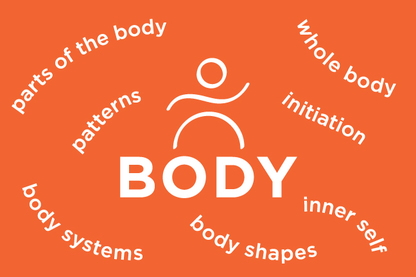
Several subcategories of body are:
Initiation of movement starting from specific bodies
Connection of different bodies to each other
Sequencing of movement between parts of the body
Patterns of body organization and connectivity
Question 1
Create an easy-to-remember acronym with the subcategories of body listed above.
-----------------------

4
Patterns of Connectivity
With knowledge of Laban's concepts, via Bartenieff, Peggy Hackney identified six developmental patterns of body connectivity: breath, core-distal, head-tail, upper-lower, body- half, and cross-lateral.
Standing
Lateral
Core Distal
Upper Lower
---------------------------------------------
IV. FLOOR
Early Patterns of Total Body Connectivity.
Question 2
After trying and/or observing the different movement patterns, explain how did it feel to put your body through this work?
------------------------------------------
5
Laban-Baternieff
5 Developmental Movement Patterns
Naval Radiation
Spinal
Upper Lower
Body Halves
Cross-Lateral
Question 3
In which way are the developmental movement patters important in expanding the dancer's body range of motion?
--------------------------
V
A Note to Remember
Fundamental movement patterns have emerged
throughout development and are omnipresent across cultures of the world.
VI
Combine all the patterns of body connectivity explained in each video, and create an 8 movement ensemble phrase using Duncan based movement style.
PATTERNS
- Lateral
- Core Distal
- Upper Lower
- Naval Radiation
- Body Halves
- Spinal
- Cross Lateral
- Floor (Early patterns of total connectivity)
RECORD IT AND POST IT ON DISCUSSION BOARD
VII
Glossary
VIII
Sources
Bassp, J.C, et al (2021). Dance on the Brain: Enhancing Intra- and Inter-Brain Synchrony.
https://www.researchgate.net/publication/348306172_Dance_on_the_Brain_Enhancing_Intra-_and_Inter-Brain_Synchrony
Total Body Connectivity–Breath Patterning. https://us.humankinetics.com/blogs/excerpt/total-body-connectivity-breath-patterning?srsltid=AfmBOopPFdRlgvWzY1aY-8KC7IG5VRhA8JGm9bJae4CjxDryCCszpATj
IX
Journaling
X
Students' Work


Comments
Post a Comment